

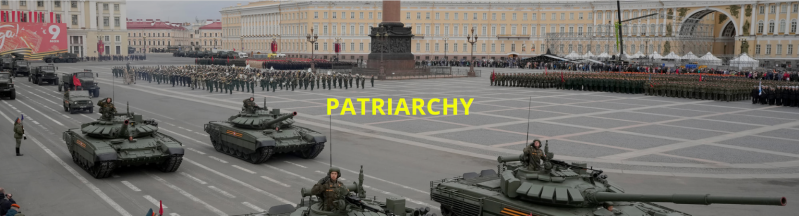
Introduction and brief definition of patriarchy
From the Oxford languages dictionary: "A patriarchy is a system of society or government in which the father or eldest male is head of the family and descent is traced through the male line." "A patriarchy is a system of society or government in which men hold the power and women are largely excluded from it."
"Patriarchy" is a label that I assign to a human cultural, social, economic and religious system whereby humans can derive self meaning and organize themselves to function as family units, organize into social groupings, conduct economic, governmental and military activity and deal with other human social entites and their environment. In a patriarchy, the male holds power and male values dominate in the culture and the conduct of social affairs. Some of these male values are the use of violence of all kinds, domination, vertical power structures, separation into different groups according race, gender, ethnic origin, religion, and sexual orientation, etc. Women are not allowed to hold power and are traditionally relegated to childrearing, taking care of the home and providing for the sexual wants and needs of the males. Entitlement is a predominant attitude in patriarchy. "Special-ness" is a strong patriarchal attitude. The concept of private property of all kinds is a key patriarchal economic concept. Patriarchy is strongly opposed to Holistic concept.
It is my conviction that human patriarchy has generated an enormous amount of violence, exploitation, death, pain, and suffering throughout the course of recorded human history. And patriarchy has now brought humanity into an ecological crisis of climate change, species extinction and loss of natural resources. And this same patriarchy has brought the human species to the verge of now multiple existential crises, labeled the "Polycrisis" that includes potential nuclear self-annihilation, civilization collapse due to climate change, and now the new threat posed by Artificial Intelligence (AI).
It is essential that we come to understand patriarchy's subtle tenants & values deeply buried in our religion and culture and the serious threat it poses for our future. These topics are discussed below. I believe we need start discarding patriarchy's dangerous and obsolescent grip on our minds and society. Then we can make a clear choice and transition to a more holistic, much less violent and much more sustainable future. The Sustainability page on this website is devoted to this holistic path to a better future.
CRIME AND PUNISHMENT
Fascism Scorecard: Obsession with Crime and Punishment
Posted October 8, 2026
Summary: The gruesome botched execution of Christa Pike has clearly exposed the moral bankruptcy and rational absurdity of capital punishment. Capital punishment is revenge. Revenge is not justice. Justice is not revenge.

New York Times 10/01/2026
The State of Tennessee has totally botched the execution pf Christa Pike, the first woman scheduled to be executed in the state in more than 200 years. After her last appeal ran out and the US Supreme Court gave the go-ahead for Christa Pike’s execution, everything on her path to death seemed to go according to plan. Then the screw-ups began. According to the news reports, Christa herself had to assist her executioners in finding a vein to insert the intended fatal dose of pentobarbital. Things got worse from there. The dose did not enter her vein and was injected into her arm tissue instead. After the first dose didn’t work, her would-be executioners injected her with a 2nd dose. Then the curtains were closed. The public doesn’t need to witness this grotesque circus that followed.
The 2nd dose didn’t work. She was apparently unconscious, but still alive. This botched execution was called off. What happened next?! “Call the ambulance!” The state suddenly switched from killing a person to saving a life. She was rushed off to the hospital where life-saving efforts were unleashed. Still unconscious, in critical condition, and shackled to her gurney, after a day, the state was about to cut off her “life-support” systems. Now, in this gruesome sequence of events, Christa regained consciousness before life support was ended. She is now in a long recovery period back to life with the help of her medical caregivers. The State of Tennessee, taken aback by this debacle has suspended all state sponsored killing for the rest of the year. Christa’s fate appears to be uncertain. Do they restore her back to normal health and try to kill her again? The prospect of this is sickening.
Even taking her crime into consideration, the state has treated her with incredible brutality. She has spent 32 years on death row, and a lot of that in solitary confinement because there are no other women on Tennessee’s death row. Just think of it: 32 years, behind bars in maximum security prison and a lot of that time on death row, with nothing to look forward to except being killed at the end.
This is only a part of this gruesome hypocrisy surrounding government executions in this country. Killing a person is about the most violent thing you can do to them. But the government is trying to rationalize this extreme violence by hiding behind a façade of humane treatment. “Let’s make this murder appear as humane and painless as possible. That shows what nice guys we are!” “This is a humane punishment in accord with the 8th amendment, right?!” The whole show, nowadays, has exposed the moral bankruptcy and the rational absurdity of capital punishment. I guess that using a firing squad, which is what Christa requested, is far too messy and inhumane. Blood and body parts, bullet pocks in the wall, and wrapping up a bloody and disintegrating corpse into a bag and inserting that whole mess into a box would be a messy undertaking. And now the cleaning crew must come in, mop up the blood and pieces of flesh, flush it all down drain and then maybe even plaster up the bullet holes in the wall.
But there’s more to this story. There were the voices calling for Christa’s execution. It appears that Christa was a violent person and apparently attacked a fellow inmate and tried to kill her also. These are the voices for punishment: “an eye for an eye, a tooth for a tooth, a life for a life.” Make the criminal suffer. To me, this sounds like revenge. The thinking is that justice consists of imposing an appropriate punishment for crime. Punishment differs little from revenge. And revenge is not justice. This is just another exercise in violence. This differs little from my dog snarling at another dog who approaches his food bowl.
I believe there is a better way: the renunciation of violence. Let’s leave revenge behind us. What is “justice”, anyway? Let’s consider a different approach to the concept of “justice”. Let’s start with Gemini’s overview: Justice is the quality of being fair, impartial, and morally right, as well as the legal or philosophical system used to apply laws, redress wrongs, punish crimes, and ensure people receive what they are due.”
Let's pull Jesus into this conversation. What would Jesus say? Quoting The Other Journal: https://theotherjournal.com/2006/10/jesus-justice-and-us/ “The gospels present Jesus as the justice of God as he delivers people from sin (again, prominently displayed in a preferential concern for the downtrodden and oppressed) and restores human relations/communion. Central to this justice is the mercy or forgiveness that in the name of reconciliation foregoes retribution and retaliation.”
And then there is my prophet, Lao Tzu from the Tao Te Ching: “Weapons are the tools of fear; a decent man will avoid them except in the direst necessity and, if compelled, will use them only with the utmost restraint. Peace is his highest value. If the peace has been shattered, how can he be content? His enemies are not demons, but human beings like himself. He doesn’t wish them personal harm. Nor does he rejoice in victory. How could he rejoice in victory and delight in the slaughter of men?”
What might criminal justice look like in a non-violent system. The justice system in Norway can offer us a good example:
From Wikipedia: Incarceration in Norway is one of the primary forms of punishment and rehabilitation for individuals convicted of criminal offenses.
Norway's criminal justice system is organized around the principles of restorative justice, rehabilitation, and the normalization of daily life in prison. Correctional facilities in Norway focus on maintaining secure custody while supporting the social reintegration of offenders, following the idea that life inside prison should resemble life outside as closely as possible within safety limits.
Per capita, Norway has one of the lowest recidivism rates globally; in 2018, the reconviction rate was 18 percent within two years of release and 25 percent after five years.[1] Per capita, the country also reports relatively low overall crime rates.[2][3][4] Norway's prison system houses approximately 3,000 individuals at any given time.[5]
Norwegian law prohibits the use of torture and other cruel, inhuman, or degrading treatment as punishment. Prison conditions generally meet international human rights standards, and independent organizations regularly monitor facilities. Prisoners also have access to an ombudsman who can investigate complaints about public authorities.[6]
Norway does not use capital punishment or traditional life imprisonment. The maximum custodial sentence is 21 years (30 years for crimes against humanity, with life imprisonment applicable only under military law).[4] Courts may extend an offender's sentence in renewable five-year increments if the individual is judged to remain a significant risk to society.[7]

Interior in Larvik Prison.

Interior in Halden Prison
This could be a very long and involved discussion. To sum up, let’s end the structural violence of the American “correctional system” (“punishment and warehousing system”). Let’s repeal capital punishment immediately, starting with Christa Pike. And let’s embark on changing our American criminal justice system, currently focused on punishment, “corrections” and warehousing criminals into a system focused on restorative justice, rehabilitation and normalization of daily life. Let’s transition from “Department of Corrections” to “Department of Rehabilitation”. Rather than becoming more dangerous, this system could make us safer and more humane in the long run. Norway is one of the safest countries on earth.
CRUELTY
Posted August 29, 2026
Cruelty
It’s been a year and a half since the Trump regime gutted the United States Agency for International Development (USAID) agency. One of the consequences of this was the cut-off of humanitarian aid for areas of rural Afghanistan. This cut-off of aid has had devastating consequences for the health of this population, and especially cruel consequences for mothers and their starving small children and lack of necessary medical care. This medical care was being provided by USAID and American generosity.
Here are images from a PBS Newshour Report, dated August 25, on this situation.

Images of sick and starving children in this area.


And what is our State Department concerned about? Keeping US funds out of the hands of terror groups.
The State Department also cited a March 2025 inspector general's report on Afghanistan that said aid groups -- quote -- "needed to strengthen agreements with public international organizations to ensure that U.S. funds are not diverted to terror groups."
Presumably these rural Afghan terrorists who were investigated in this report.
More Cruelty
Shift the focus to Gaza and another PBS Newshour report. Note: PBS Newshour has a reputation for being non-partisan and editorially “moderate” in its reporting. However, some of its reports are quite stark and hard-hitting.

This NewsHour story aired on August 27, is a report about young people, trying to grow up in their devastated homeland in Gaza. Some teenagers are taking to surfing in the waters of the Mediterranean Sea on surfboards that are older than they are. Israel prohibits the import of surfboards into Gaza.
This story also shows a young Gaza boy, missing a leg, who builds a kite and then takes it out and flies it. Kite flying in Gaza is hazardous because the IDF may mistake kite flying for a hostile intent to fly explosives into Israel. In some cases, kite fliers have been targeted and killed. https://www.pbs.org/newshour/show/gazas-traumatized-youth-search-for-glimmers-of-hope-in-devastated-homeland

Many families live in tent cities next to the devastated buildings that used to be their homes. Who knows how many of these children, struggling to create lives for themselves, will be haunted by PTSD for the rest of their lives?

Art inspired by the Gaza experience.
Meanwhile, on the seacoast of Tel Aviv:

Photo credit: Wikipedia
This contrast is mind boggling and obscene. What kind of species are humans?
Comments About Communism
Despite the risk of being labeled a "Marxist", I share the following observations about the word "Communist". That word is becoming more popular these days in American political discourse.
“Communism!” Oh no! It’s one of those conditioned reflex words. It’s right up there alongside other reflex words: Devil, Demons, Queers, Atheists, & Socialist. A number of years ago, the word “communism” became one of those conditioned reflex words, designed to elicit a well known emotional and hostile reaction, a process not entirely unlike Pavlov and his dogs.
Let’s hold our nose and take a closer look: how evil is Communism in today’s world?
Made in China
Have a look around your house: maybe your Iphone, your computer monitor, that new set of dishes in the dining room, your latest high fashion tee shirt, or those attractive new jeans hanging in the closet. “Made in China” says the tag or label.

Made in that evil Communist country we call China. That large container ship pulling up to the dock in Long Beach, full of containers with goods made in (oh, no!) Communist China. China was America’s 4th largest trading partner in 2025. https://en.wikipedia.org/wiki/List_of_the_largest_trading_partners_of_the_United_States

Hmmm… The greatest American leader of all time, Donald Trump, surely must be enemies with Xi Jinping, the leader of that evil Communist country, right? Wrong. Just the opposite is happening. “U.S. President Donald Trump publicly praised Chinese President Xi Jinping, telling him “it’s an honor to be your friend” and labeling him a great leader.” – Gemini AI overview. But wait, there’s more: Trump traveled with a delegation of top (capitalist) business leaders, expressing a strong desire to expand reciprocal trade and business ties with China. [1, 2] Apparently all strongly capitalist American (and Western) business leaders are anxious to do business with the evil Chinese Communist empire.

Standard of Living
I wonder how all those starving peasants, living in huts and sleeping outside, are getting along in that horrible Communist country. Oh, wait a minute. It appears that China, far from having a housing shortage, has a huge housing surplus. This housing glut, 60 to 90 million vacant apartments, is so large that it has tanked the housing market. China faces a historic housing oversupply with an estimated 60 to 90 million vacant apartments. This glut is driven by overbuilding in smaller cities, speculative investment, and a shrinking population, resulting in a prolonged market slump and steep price drops. [1, 2, 3, 4, 5, 6] Meanwhile, back in the capitalist countries, driven by “free markets” and capitalism, there are historic housing shortages almost everywhere: the US, Canada, the UK, France, and even Australia.

(image taken from the Guardian)
Surely Communism in China has been bad for the standard of living for the average Chinese citizen, right? Wrong. It appears that since Communism came to China almost 80 years ago, the Chinese standard of living has risen from widespread poverty to widespread middle class levels.
(Here's what Gemini AI says about this.)
Over four decades of market reforms, average life expectancy rose, over 800 million people escaped absolute poverty, and massive gains were made in housing, diet, and infrastructure. [1, 2, 3, 4]
Traditional Era to 1949
- Stagnant Real Wages: Real incomes and living standards saw little cumulative change across centuries, often constrained by rapid population growth matching food production gains. [1, 2, 3]
- High Insecurity: Widespread poverty, periodic famines, and foreign or domestic conflict left the general populace economically vulnerable. [1, 2]
The Mao Era (1949–1978)
- Basic Health and Education: Modest gains occurred in basic literacy and public health, raising average life expectancy from roughly 44 years in 1949 to the mid-60s by the late 1970s. [1, 3]
- Material Scarcity: Centralized planning and strict collectivization kept per capita availability of food, clothing, and housing largely stagnant and tightly rationed. [1, 2]
Reform and Opening Up (1978–2010s)
- Agricultural Decollectivization: The household responsibility system boosted farm output and improved rural diets quickly in the early 1980s. [1]
- Urbanization and Jobs: Millions moved from farming to manufacturing and services via township enterprises and urban migration, fueling consumer abundance (electronics, appliances, and later automobiles). [1]
- Poverty Alleviation: Decades of economic growth systematically reduced the rural population living in absolute poverty. [1, 2]
Modern Era (2010s–Present)
- Eradication of Absolute Poverty: Targeted state campaigns declared an official end to extreme rural poverty under current national benchmarks by 2021. [1]
- Advanced Infrastructure: High-speed rail networks, widespread digital connectivity, and massive automobile ownership became standard for hundreds of millions. [1, 2, 3]
- Rising Inequality: Private wealth accumulation led to income inequality metrics that currently approach those of the United States. [1]
Assuming the above AI overview is correct, the evil Communist government in China has succeeded in eradicating absolute poverty and has constructed a new network of advanced infrastructure. Has free market capitalism succeeded in eradicating poverty here in the US? Judging from all those homeless people camped out on sidewalks and alongside our highways, I would say not. To be sure, rising inequality, so widespread in the US, has now also come to this Communist country.
Environment & Renewable Energy
Surely this Communist regime in China is just obsessed with power and doesn’t care about climate change or the environment, right? Actually, this Communist country is leading the global transition to renewable energy.
Gemini AI again:
China is expanding its renewable energy capacity at a historic pace, installing over 430 GW of renewables to reach a total of more than 2.34 TW. Clean generation from wind and solar now accounts for over 40% of total power output, driving a historic reduction in domestic coal-fired electricity generation. [1, 2, 3]
Scale and Manufacturing Dominance
- Unprecedented Buildout: China installs more wind and solar capacity annually than the rest of the world combined, vastly exceeding its original climate targets ahead of schedule. [1, 2]
- Global Supply Chain: Chinese factories produce roughly 80% of the world's solar panels and 70% of wind turbines, driving down global clean technology costs. [1, 2]
- Economic Impact: Clean energy manufacturing and investment contribute trillions of RMB, acting as a primary engine for the national economy. [1]
Grid and Integration Challenges
- Transmission Bottlenecks: Most renewable megaprojects are built in remote northwestern deserts ("Shagehuang" regions), while major power demand sits on the industrialized eastern coast. [1, 2]
- Curtailment Rates: Rapid generation growth has outpaced high-capacity ultra-high-voltage power lines and localized grid flexibility, leading to wasted renewable output in certain provinces. [1, 2]
- Storage Investments: Battery storage deployment and grid infrastructure spending are scaling up rapidly to help balance intermittent solar and wind flows. [1, 2]

It would appear that this Communist country is leading the way on generating renewable energy and implementing its own transition to renewable energy. According to this report, China derives 40% of its total energy from renewable resources. Meanwhile, back in the capitalist US, renewables account for only 25% of total electrical generation.
One other selected observation about this Communist country in which entrepreneurial companies seem to thrive, is this country’s success in designing and building affordable electric vehicles.
Again: Gemini AI speaking:
China is the largest electric vehicle (EV) market in the world, producing over 70% of global EVs and driving rapid innovations in affordability, battery-swapping, ultra-fast charging, and smart cockpit tech. Major manufacturers like BYD, Geely, Xpeng, and Nio dominate domestic sales and are expanding aggressively across Europe, Australia, and Asia. [1, 2, 3, 4]
Top Chinese EV Brands & Market Position
- BYD (Build Your Dreams): The world’s top seller of fully electric and plug-in vehicles, known for vertical supply-chain integration and budget-to-luxury offerings.
- Nio: Famous for premium smart EVs and pioneering automated 4-minute battery-swapping stations.
- Xpeng: A technology-forward brand known for advanced driver-assistance systems and experimental modular flying car concepts.
- Geely & Zeekr: Offer high-value, tech-heavy SUVs and sedans popular in international export markets. [1, 2, 3, 4, 5, 6]
Key Factors Behind Their Success
- Supply Chain Control: Long-term government support and localized battery production allow Chinese automakers to drastically undercut Western competitors on price. [1, 2, 3]
- Advanced Technology: High-end infotainment, integrated refrigerators, fast-charging architectures (replenishing up to 70% in minutes), and sophisticated autonomous driving software come standard on many mid-tier models. [1, 2, 3]
- Global Expansion: While heavily restricted or blocked in the United States via 100% tariffs and trade barriers, Chinese EVs have captured substantial market share throughout Europe, the UK, and Australia. [1, 2, 3]
BYD: One of the Chinese EV manufacturers: https://www.byd.com/us

The US has imposed prohibitively high tariffs on Chinese electric vehicles, resulting in effective tariff rates of 127% to 245% in an effort to support the local electric vehicle industry. This Communist country appears to be far ahead of the capitalist economy in the electric vehicle market.
Freedom
How about freedom in this Communist country? Now we encounter the worst feature of Chinese communism. There is a distinctive difference between China and the West. Compared to the US, China has low levels of freedom.

This map is taken from Freedom House. https://freedomhouse.org/explore-the-map?type=fiw&year=2026
The press and internet are tightly controlled. There is no freedom of speech, no freedom of public protest and little freedom of movement. The emphasis in Communist China is on collective stability and low violent crime rates, while the emphasis in the US is on preserving individualism. The clear winners in the freedom category are the US and the Western countries. However, this rejoicing should be tempered with the recent trends towards authoritarianism and loss of freedoms, especially since the ascension of DJT back into power in 2024.
PBS Newshour recently carried a story about a Christian pastor recently released from Communist China. https://www.pbs.org/newshour/show/the-party-is-in-charge-of-everything-freed-pastor-says-of-chinas-crackdown-on-religion

Conclusion:
Far from being that well-known horror word, left over from the Joe McCarthy era, “Communism” is a word that currently describes a system of government that has brought substantial economic improvements to China, along with a loss of individual freedom.
“Communism” in the American mind at least, is associated with the Russian brand of despotic authoritarianism, characterized by the two Russian tyrants: Joseph Stalin and Vladimir Lenin. Communism is associated with the Cold War with the Soviet Union, which started shortly after the end of World War 2 and ended with the fall of the Berlin Wall. The Russian brand of Communism failed and the Soviet Union has transitioned to a very autocratic oligarchy which is now engaged in a long endless war of conquest upon its neighboring state of Ukraine. There is much of the Russian brand of communism that had nothing to do with Marx’s vision of a communist state.
Again, at the risk of being labeled a Marxist, let’s stop using the word “Communism!” as a swear word, fear word or derogatory label to dehumanize someone else. Take another glance at the “Made in China” label on your iPhone or computer monitor. In our social discourse, “Socialism” or “Communism” could be regarded as alternative terms in sandbox lingo for “Share the Toys!”.

America and its Native Peoples
America has an unsolved problem. White settlers from Europe caused a terrible holocaust of Native Americans in North, Central and South America. As soon as they arrived in the 1600's, America’s white European settlers started fighting with Native Americans, killing them and taking their land.
America's war with the natives has gone on for over 300 years. It started long before the Revolution and continued up until 1923, even after WW1 was over.
The Nazi Holocaust killed 6 million Jews, 50% of the 12 million Jews in the world at the time. This is a truly horrifying event by any standard. The holocaust that the European settlers brought to Indigenous peoples in the Americas is far worse. When this holocaust was over, only 300,000 of 10,000,000 Native peoples were left. 97% of all Native people were wiped out.
They were killed by war, slavery, starvation and diseases that were brought over by the Spanish, Portuguese, and British Europeans:

The Declaration of Independence, which declares that “all men are created equal”, did not apply to Native Americans, as well as to enslaved Black Americans. The Declaration dehumanized Native Americans, calling them “merciless Indian Savages”. Some of the soldiers who fought in the Revolution were rewarded with plots of land taken from the Indians.

The Native people fought back, of course.
This resulted in famous battles, like “Custer’s Last Stand” and not-so-famous episodes, like the Wounded Knee Massacre.
After the Custer battle in 1876, the white Europeans, in both the US and Canada, resorted to breaking up Native families, taking children away from their mothers and sending them off to “boarding” school, where they tried to turn these Native Americans into white people.

Manifest Destiny

A Mountain of Buffalo Skulls.

There is a huge moral debt that America owes to these surviving Native peoples.
What can we do to make this right?
Let’s seek to restore equity for one thing. Native American reservations should not be centers of poverty, drug abuse and disease. They should be as prosperous as a typical American town or city.
Giving the land back is not an option. “Land use acknowledgements”, while they sound noble, are basically hypocritical.
Ultimately, in my opinion, there are two long term goals that can help make things right:
First, we must come to regard ourselves, both white, Native American, black people: everyone as one united people: “All men (women) are created equal”.
Second, we must change our relationship with the land: the land does not belong to us. We belong to the land. We are all children of “Grandmother Earth” and we must all strive to live together in peace.

Posted 7-21-15
Seen on a nearby garage door:

250 years of freedom, except for:
- Black Americans who were enslaved, segregated and lynched
- Native Americans who were killed, their land stolen and their children sent to boarding schools
- Women, who couldn’t own property or vote
- Japanese Americans who were sent to internment camps during WW2
Recommended Books

Fields of Blood: Religion and the History of Violence -- by Karen Armstrong
There is an intimate relationship between religion and human violence. Religion of all kinds have often been used, and is still being used today, as a moral sanction for all manner of horrific violence. This relationship between religion and violence throughout recorded human history has been extensively, authoritatively and even handedly documented in this book by Karen Armstong. Armstrong is not one-sided and also points out the instances where religion has been used to promote peace, kindness and non-violence. Overall, this necessary, but depressing book, should be required reading for people who are concerned about violence and its relationship to religion.
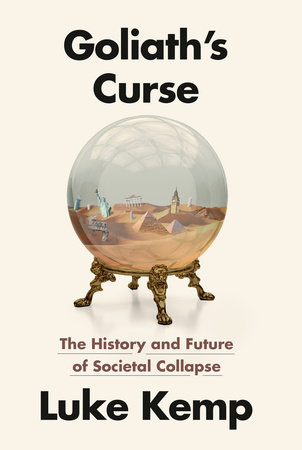
My comments: "Goliath" is the term the author uses to refer to hierarchical and often authoritarian forms of government and human domination based on patriarchal principles. This book is an important primer on authoritarianism throughout human history: its orgins, how it dominates, its weaknesses and its future. This book is a grim read, but well worth the effort.
(Publisher's comments:) In Goliath’s Curse, Cambridge scholar Luke Kemp conducts a historical autopsy on our species, from the earliest cities to the collapse of modern states like Somalia. He traces the emergence of “Goliaths”: large societies built on a collection of hierarchies that are also terrifyingly fragile, collapsing time after time across the world. Drawing on historical databases and the latest discoveries in archaeology and anthropology, he uncovers groundbreaking revelations:
- More democratic societies tend to be more resilient.
- In our modern, global Goliath, a collapse is likely to be long-lasting and more dire than ever before.
- Collapse may be invisible until after it has occurred. It’s possible we’re living through one now.
- Collapse has often had a more positive outcome for the general population than for the 1%.
- All Goliaths contain the seeds of their own demise.
As useful for finding a way forward as it is for diagnosing our precarious present, Goliath’s Curse is a stark reminder that there are both bright and dark sides to societal collapse—that it is not necessarily a reversion to chaos or a dark age—and that making a more resilient world may well mean making a more just one.
https://www.penguinrandomhouse.com/books/691357/goliaths-curse-by-luke-kemp/
Trump Is A Sick Man
In the first 4 minutes of the video below (ignore the click-bait title), Professor Jeffrey Sachs gives the most accurate and concise definition of Donald Trump’s mental state that I have come across in a long time. When we observe or listen to Donald Trump, we are paying attention to a sick man. And as Professor Sachs also points out in later in this video, the mainstream news media tends to take the pronouncements and behavior of this sick man far too seriously. This unwarranted attention and credulousness of the mainstream media, regardless of whether it is in favorable or unfavorable, is exactly what this sick man wants. Furthermore, this unwarranted seriousness is greatly distorting the “truthiness” of our collective perception of reality. We would do well to cling to a non -Trump perception of reality that tends to be impartial and empirically verified.
Here are some of the terms that Sachs uses to describe Trump's mental illness.
Malignant Narcissism -- Malignant narcissism is a severe, destructive personality syndrome blending extreme narcissistic personality disorder (NPD) with antisocial behavior, sadistic cruelty, and paranoia. Coined by Otto Kernberg, it features a lack of conscience, high aggression, and a need for control, often causing deep emotional or physical harm to others. It is not a formal diagnosis in the DSM-5-TR, but a recognized, dangerous, and often untreatable form of pathology.
Psychopathy -- a persistent pattern of antisocial, impulsive, manipulative, and sometimes aggressive behavior, sometimes described as a personality disorder (not in current technical use).
Frontotemporal Dementia – Frontotemporal dementia (FTD) is a group of disorders caused by progressive nerve cell loss in the brain's frontal or temporal lobes.
Phonemic Paraphasia -- a speech error where sounds within a word are substituted, added, or transposed, resulting in unintended words or non-words that often sound similar to the target
Confabulates – “brain unconsciously fills gaps in memory with fabricate, distorted and misinterpreted information.”
-
Patriarchy's Tenets & Values
-
Patriarchy in Contemporary Culture
-
Patriarchal Religion
-
Patriarchy in History
-
My Personal History with Patriarchy
-
Roots of Patriarchy in Biology & Human Nature
-
Patriarchy's Current Crisis & Recovery from Patriarchy
-
References